Saturday, January 30, 2010

Why did My Daily List fall off the face of the Earth?

Why did My Daily List fall off the face of the Earth?

1. After years of hobo obsession, he finally packed his bindle and hit the open road.
2. My Daily List was designed to continue for 1001 lists but walking away from the responsibility of writing a daily list is best for the fine people of Alaska.
3. You don't know it yet but mydailylist made it through Hollywood week and is one of the top 24 on American Idol.
4. He decided to rest on his laurels but he recently received his laurels in the mail and realized that they are highly unrestful bay leaves, so screw it.
5. He was content to simply watch television in the evening without the burden of writing a list. Then, Julia Roberts made a movie and they started showing a commercial with her donkey-face laughing that laugh that makes angels punch babies. So he started listing again.
6. He's been spending a lot of time in Crawford rockin' and reminiscin on the front porch with W.
7. He briefly took over Jay Leno's blog but then that jerk decided he wanted it back.
8. My Daily List's primary audience was women over the age of 90 so his following eventually died off. Now he's back to appeal to a fresher, younger audience with lists on such diverse topics as the Korean War, frozen TV dinners, and Ed Sullivan.
9. Had been distracted by the shiny ribbons from Christmas presents.
10. What? He stopped listing? I didn't notice.

noreply@blogger.com (My Daily List) Wed, 27 Jan 2010 03:22:00 +0000

To read the full article click here.

To unsubscribe from this feed, click here

To manage your other subscriptions, click here

Powered by RSS:Forward

Tuesday, January 26, 2010

How To Write A Viral Blog Post: 7 Real Examples

Thank you for using rssforward.com! This service has been made possible by all our customers. In order to provide a sustainable, best of the breed RSS to Email experience, we've chosen to keep this as a paid subscription service. If you are satisfied with your free trial, please sign-up today. Subscriptions without a plan would soon be removed. Thank you!

This is a guest post by Diggy. If you want to guest post on this blog, check out the guidelines here.

I don't usually write about blogging or writing but today I'm making an exception. While doing some browsing and stumbling, I decided to look at the top articles on Stumbleupon (a social sharing network) about self improvement to get some ideas for new posts. I was amazed to see articles getting 140,000 views. One article, getting that many views? I think that is what every writer and blogger wants.

So what is the secret? You are about to get a bit closer to the answer.

Top 7 Stumbleupon Self Improvement Articles

These are just 7 of the top posts on Stumbleupon in the Self Improvement niche. There are many more on the web, but I think the ones I listed should serve as enough of an example of viral blog posts.

1. What Are Your Eyes Giving Away?

What is it about:
Learning how to read people's intentions by their eye-movements and expressions and the visual clues they give.

Why it is interesting:
Everybody wants to have the skill of being able to know someone's intentions or feelings by looking in their eyes and reading their visual clues. It's a source of power and seems like a really cool thing to be able to do. Just by reading the title and understanding the topic of the article, it makes me want to start reading it and find out what it is about.

Why it makes me want to share it:
It's neatly presented, broken down into easy-to-read paragraphs and contains interesting pictures. It is not too long and has some good facts and information I never knew about, so that is something I would easily share or send to my friends. Cool facts and pieces of knowledge are always something that people share.

2. 33 Ways To Get And Keep Yourself Motivated

What is it about:
A list post of 33 ways to get and keep yourself motivated.

Why it is interesting:
List posts are always interesting to read because with so many reasons about a topic I'm interested in (motivation), there are bound to be a couple good ones that I can learn from.

Why it makes me want to share it:
List posts are the most common kind of posts that get shared very easily. A list is something that everyone can relate to, and the more reasons on the list, the more likely a reader is to find something that they can relate to on a strong level. If you have a friend or family member that needs some motivation, a list like this one is perfect to send to them or share on the web.

3. Ten Strange Places

What is it about:
Ten strange locations in our world. Places both weird and wonderful and amazing to see.

Why it is interesting:
Travel is one of those global topics that almost everyone is interested in. Our world has so many hidden treasures and beautiful places. It is always fascinating to see pictures and learn more about our world. This post has ten incredible places in the world, with some interesting facts about them and gorgeous pictures!

Why it makes me want to share it:
Beauty is worth sharing! Pretty pictures and awesome locations in the world? That is definitely a recipe for a post that I want to share with the world and my friends.

4. 40 Tips for a Better Life

What is it about:
40 Different ways how you can improve your life.

Why it is interesting:
Everybody likes to think that they are living life the right way. I also like to think this, but I know there is always plenty of room for improvement. That is why this post is so appealing, it arouses curiousity to see if there is a way in which you can improve your life.

Why it makes me want to share it:
It's an awesome list post. Easy to read with some valuable wisdoms that I would want to share with others.
I know that it is easy to read and won't be a nuisance to others, but more of an asset to them, and that is exactly why I'd share this post.

5. How to Become a Better Husband, Boyfriend or Life Partner

What is it about:
This article is about being the best man you can be for yourself AND for your lady. Written by a man for other men.

Why it is interesting:
Relationships rank high in the list of most important things in the world. I for one am always curious about what other people say about relationships and how to maintain them. This post lists a whole lot of reasons in easy-to-read paragraphs. A nice length and rather informative.

Why it makes me want to share it:
Good relationship advice is always welcomed by others. Besides that, it was fun to read and enjoyable, and that is exactly why I'd share it.

6. How to Live a Better Life with Less

What is it about:
Achieving more by doing less.

Why it is interesting:
The concept of being able to live a better life and do more by actually doing less is an interesting concept in itself. The post is broken down in easy-to-read paragraphs with headings. In today's world we are all so busy doing things, that we forget by doing less and the essential, that we can focus on the things we really want to do.

Why it keeps my attention and makes me want to share it:
It contains an important truth of cutting out the unnecessary and focusing on what you want to do. I would share this because it can genuinely help people make their lives better.

7. How Much Of Life Are You Actually Living?

What is it about:
Life and how you are letting it pass you by.

Why it is interesting:
So many of us all live for the weekend, or for the holiday, or the promotion in 5 years time. This post questions the way you live your life and if you are letting it pass you by. Very thought-provoking.

Why it makes me want to share it:
Exactly for that reason mentioned above. To give people a wake-up call so that they can realise if they are letting life pass them by.

How To Create a Viral Blog Post

List Posts:
The majority of the posts that go viral seem to be list-type posts. "X reasons to do something" or "X ways to be inspired". The reason that these posts are so easily shared is that they are easy to read and there is always one or more reasons that relates to the reader. That is why they feel happy to share it and go through the trouble.

Interesting Topics:
Posts that go viral are often about topics that everybody has an interest in. Travel, life, money, sex, relationships. These have a broad appeal and are likely to be shared.

How-to Posts:
If you can provide a solution for a problem then people are grateful. If you can provide a solution for a common problem that many people have, the chances are big that your post will get shared by everyone who finds your solution helpful.

Of course not every post that you write in one of the above three styles will ensure that it goes viral. however, I think that it will greatly increase your chance for creating a diamond in the rough, a post that will get thousands if not hundreds of thousands of views. If your aim is to create viral blog posts, or even just one or two to get more traffic to your blog and new readers, then it is worth it to write articles in one of the three styles I mentioned above (or a combination of the styles).

Diggy writes all about self improvement at his blog UpgradeReality. If you are looking for motivation, inspiration or useful tips to live a better life, subscribe to his articles via RSS or Email.


Original Post: How To Write A Viral Blog Post: 7 Real Examples

Guest Author 27 Jan, 2010


--
Source: http://www.dailyblogtips.com/how-to-write-a-viral-blog-post-7-real-examples/
~
Manage subscription | Powered by rssforward.com

TechCrunch Hacked?

Thank you for using rssforward.com! This service has been made possible by all our customers. In order to provide a sustainable, best of the breed RSS to Email experience, we've chosen to keep this as a paid subscription service. If you are satisfied with your free trial, please sign-up today. Subscriptions without a plan would soon be removed. Thank you!

I was browsing through my RSS feed when I came across a curious (to say the list) post from TechCrunch, when they mention they have been hacked.

I figured it could be Michael Arrington jumping the gun on April's Fools again (and setting a new world record at the same time…), but after reading the comments it looks like the most popular tech blog on the web was indeed hacked.

Apparently for some time whoever tried to access TechCrunch.com was redirected to another site. You can get more details from the comments.

The site seems to be working normally now, but it will be interesting to read their follow up on the issue, mainly to understand what kind of vulnerability was exploited.


Original Post: TechCrunch Hacked?

Daniel Scocco 27 Jan, 2010


--
Source: http://www.dailyblogtips.com/techcrunch-hacked/
~
Manage subscription | Powered by rssforward.com

Book Review: The Purple Cow

Thank you for using rssforward.com! This service has been made possible by all our customers. In order to provide a sustainable, best of the breed RSS to Email experience, we've chosen to keep this as a paid subscription service. If you are satisfied with your free trial, please sign-up today. Subscriptions without a plan would soon be removed. Thank you!

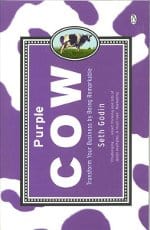
purple-cowI am a bit late with this book review, but from now on I'll try to stick with the schedule, which is one review every two weeks. Anyway today's book is a short but powerful one: Purple Cow. It is my first read from Seth Godin (what I shame, I know), but after going through it I already placed three of his other books on my to-read list.

1. The book: The Purple Cow is about being remarkable (and how this is essential to make your business prosper). Have you ever seen one, after all? If you had you certainly wouldn't forget it! The book has 137, and it is very easy to read. Seth

2. The content: Initially I thought that writing a whole book to give out a simple message (i.e., you got be remarkable) was a waste of paper. After reading it, however, I can say that it is not the case.

Seth did a wonderful job explaining the whys and hows of being remarkable, including real life examples and case studies to help you understand his points better.

I also really liked his writing style. It is clear and succinct, which is the style I strive to achieve with my own text.

3. What I liked: What I most liked in the book were the real stories that Seth shares. For example, he tells you how Herman Miller managed to transform a somewhat commoditized segment – office chairs – into one with space for premium products. He did that by creating a purple cow, the Aaron chair.

4. Who would benefit from this book: Anyone who has or is planning to build a business. Be it an offline or an online business. The message of this book is one that all entrepreneurs should learn by heart.

5. Favorite quote:

You can't make people listen. But you can figure out who's likely to be listening when you talk, and then invent the right combination of Ps to overwhelm them with the rightness of your offer. Even if someone is listening your offering of "a little bit cheaper," "a little bit better," or "a little bit easier" is just a waste of time. The influential sneezers, the people with a problem to solve – they're open to hearing your story only if it's truly remarkable; otherwise, you're invisible.


Original Post: Book Review: The Purple Cow

Daniel Scocco 26 Jan, 2010


--
Source: http://www.dailyblogtips.com/book-review-the-purple-cow/
~
Manage subscription | Powered by rssforward.com

Monday, January 25, 2010

3 Smart Google Search Tips to Hunt for Guest Post Opportunities

Thank you for using rssforward.com! This service has been made possible by all our customers. In order to provide a sustainable, best of the breed RSS to Email experience, we've chosen to keep this as a paid subscription service. If you are satisfied with your free trial, please sign-up today. Subscriptions without a plan would soon be removed. Thank you!

Guest posting is one of the most effective ways to promote your blog, meet new audience and build valuable contacts. Therefore most A-list bloggers guest post and that's why if you are a blogger, you should too.

This post will help you to start: it lists some useful, yet lesser-known Google search tips that will let you find valuable guest posting opportunities in your niche.

1. Make sure you use ALL synonyms

Various bloggers use different words to invite guest authors. Some directly ask to "submit a (guest) post", others offer to become their author or write for them. Even the most straightforward invitation can be expressed in different words: you can be asked to submit, suggest or send a post for example. Here's more or less complete list of phrases bloggers use to invite people to guest post:

  • "Submit a guest post" / "Submit post" / "Submit blog post"
  • "Add blog post"
  • "Submit an article"
  • "Suggest a guest post"
  • "Send a guest post"
  • "Write for us";
  • "Become an author";
  • "Guest bloggers wanted"
  • "Contribute to our site";
  • "Become a contributor";
  • "Become guest writer"
  • "(Write for our) guest column".

Now, you may have noticed that all the phases are used in the quotation marks – this is to force Google to search for the exact match because otherwise you will get too general results randomly mentioning "post", "contribute" and "guest".

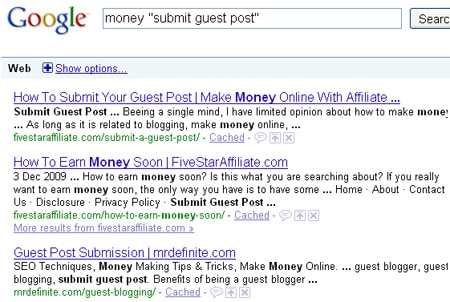
If you add some words that describe the topic of your blog, you will end up getting tightly relevant results:

guest-post-1

2. Take advantage of wildcard (*) operator

In the previous step I have mentioned using quotation marks for better search results targeting. But some guest invitations can be slightly different. For example, a blogger may write "Become our contributor" instead of "Become contributor" or "Send us your post" instead of "Send your post" but these blogs will be filtered out because we were using quotation marks and thus instructed Google to search for exact match.

So how can we include all those slightly different results without sacrificing on relevancy?

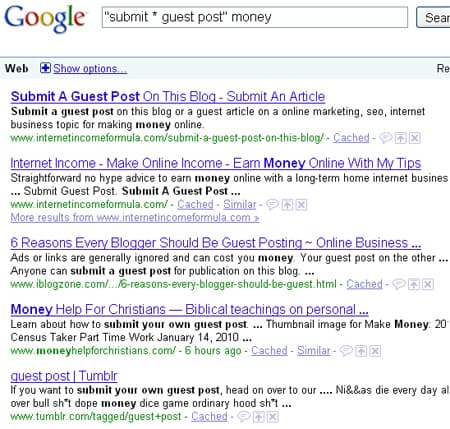
This can be done with help of Google's Wildcard operator (*) which in search results get substituted by one or more words. So if we, for example, search for "submit * guest post" search results will include:

  • "submit a guest post"
  • "submit your own guest post"
  • "submit your guest post"
  • "submit one guest post", etc

guest-post2

3. Use OR and ~ operators to better describe your niche

More often than not it is hard to describe your blog topic with one (or two) words. For example, your blog may be about money, saving, frugality, shopping, etc. The more words you use, the lesser results you will get, because Google will do its best to show you only those pages that have all of those words listed.

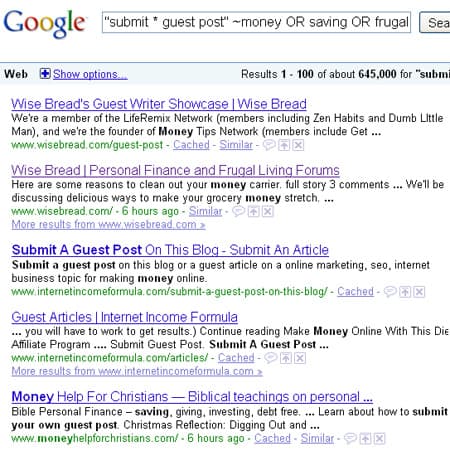
To get broader but relevant results, we should instruct Google to search for any of the words – for that we can use OR operator between the words: "money OR saving OR frugality OR shopping" because, essentially we are interested in guest blogging on sites covering any of these topics.

To go even further in this direction, we can use ~ operator before a word that may have many synonyms and related words and thus instruct Google to look for all those synonyms. For example, "~money" search will include words like "currency", "finance", "financial", etc.

So what do we have in the end after we combine all the tips? Here we go:

guest-post3

myblogguestAnn Smarty is a search geek, social media enthusiast and experienced online shopper. Ann has recently started My Blog Guest – a community of guest bloggers which aims at connecting guest bloggers to blog owners who seek high-quality content and fresh perspectives. Join the community now and promote your blog by guest posting!


Original Post: 3 Smart Google Search Tips to Hunt for Guest Post Opportunities

Daniel Scocco 25 Jan, 2010


--
Source: http://www.dailyblogtips.com/3-smart-google-search-tips-to-hunt-for-guest-post-opportunities/
~
Manage subscription | Powered by rssforward.com

Sunday, January 24, 2010

Check Out How Search Bots See Your Website

Thank you for using rssforward.com! This service has been made possible by all our customers. In order to provide a sustainable, best of the breed RSS to Email experience, we've chosen to keep this as a paid subscription service. If you are satisfied with your free trial, please sign-up today. Subscriptions without a plan would soon be removed. Thank you!

Understanding how search bots see your site is quite important for anyone interested in search engine optimization. This let's you know where your most important content should go, how the links should be structured and so on. A nice tool you can use for this purpose is called SEO browser.

seo-browser

Simply input the URL of your site there and click on "Parse URL." The result will be how search bots see your site. One rule of thumb to follow is that your most important stuff on each page (e.g., the H1 tag and the content) should be as close to the top of possible.

You can also click on "Advanced mode" to get some extra details about the head section, the statistics of your content and links and so on.


Original Post: Check Out How Search Bots See Your Website

Daniel Scocco 24 Jan, 2010


--
Source: http://www.dailyblogtips.com/check-out-how-search-bots-see-your-website/
~
Manage subscription | Powered by rssforward.com
Saturday, January 23, 2010

11 Things to Consider Before You Send the Next Email

Thank you for using rssforward.com! This service has been made possible by all our customers. In order to provide a sustainable, best of the breed RSS to Email experience, we've chosen to keep this as a paid subscription service. If you are satisfied with your free trial, please sign-up today. Subscriptions without a plan would soon be removed. Thank you!

This is a guest post by Amit Banerjee. If you want to guest post on this blog, check out the guidelines here.

Email is the primary mode of communication between Internet users. You use email to network with other bloggers, to grow your online business, to convert potential prospects into clients and so on. The micro blogging sites like Twitter, Facebook may have changed the way we share information but when it comes in communicating with web users, email is probably the simplest and universally accepted option.

Having said that, it’s obvious that you should pay attention to all those emails you send everyday. Here are a few tips for maintaining proper email etiquette:

1. Use a meaningful subject.

Just as a meaningful title makes a reader read a blog post, a meaningful subject of your email sets it apart from the crowd. A meaningful subject saves time as the recipient can grasp your idea quickly.

For example: If you want to post a guest article at Dailyblogtips and want to contact Daniel, use the subject line as “Guest article” rather than “Hello Daniel”.

Also read: 6 mistakes to avoid in Email subject lines

2. Skip the introductory paragraphs, jump directly to the point

When you are writing an email, keep the purpose in focus. Do not make the email longer by adding unnecessary introductions or links. The person whom you are writing the email may have dozens of emails to read and if you make the email long and boring, he will rather skip reading it.

Thus, avoid the boring intros and jump directly to your point. It saves time at both ends.

3. Use saved templates for answering commonly asked questions

If you get frequent emails where readers ask you the same questions, spend some time writing a template and save it in your drafts folder. Whenever you get a similar message to which you have replied before, just paste the template into the email message.

4. Add a human touch. Make it personal

I just said using templates to answer commonly asked questions. But do not overkill by making everything automated. There are some emails that will need your personal attention. So spend some time on them and try to provide some value. Not only you will get respect from the receiver, it also adds an impression that you care about your prospects.

5. Never write in capital case

WRITING AN EMAIL IN CAPITAL CASE makes it difficult to read and the receiver will get annoyed for sure. Hence, do not write an email in capital letters or else your message might end up in the trash folder.

6. Stick to the proper message thread

Including the earlier conversations in your reply is a good habit. The receiver might not remember the subject and the progress of each and every conversation. Hence an email without a thread will surely frustrate the receiver and he will have to spend some time searching for earlier threads of the conversation.

Gmail automatically includes the threads in your “reply” messages. Whenever you are replying to an email conversation always click “reply” instead of composing a new email message.

7. Read the email before you send it

Before you hit the send button, read what you have just typed. There may be spelling and grammatical mistakes which might have slipped through. Try to read the email from the receivers angle and see if it delivers the same meaning which you are trying to convey.

8. Writing a Business mail – Stay away from Smileys, Emotions and Abbreviations

I don’t know about you, but i have never seen anyone using abbreviations and smileys in business emails. Business emails should be formal as they reflect the posture of your organization or company. If you lower the weight of your business email by adding lots of abbreviations ( e.g LOL , :-) ) and smilies, chances are there that your clients won’t take you seriously.

9. Be careful with formatting

Do not try to decorate your email message with lots of colors and formatted stuff. If you unnecessarily highlight text, the email can appear to be spammy. As a general rule, use black color on a white background.

11. Use short and simple sentences

Email’s should be simple to read and should convey the meaning as quick as possible. Never think that if your writing is Shakespearean, the recipient will take interest in reading it. Keep the sentences short and simple and never write an email when you are angry – it reflects.

Do you take care of all of the above mentioned emailing habits ? Let us know through the comments section.

Amit Banerjee is a computer geek who blogs about software’s, How-to’s and web tools at Ampercent.


Original Post: 11 Things to Consider Before You Send the Next Email

Guest Author 23 Jan, 2010


--
Source: http://www.dailyblogtips.com/11-things-to-consider-before-you-send-the-next-email/
~
Manage subscription | Powered by rssforward.com

11 Things to Consider Before You Send the Next Email

Thank you for using rssforward.com! This service has been made possible by all our customers. In order to provide a sustainable, best of the breed RSS to Email experience, we've chosen to keep this as a paid subscription service. If you are satisfied with your free trial, please sign-up today. Subscriptions without a plan would soon be removed. Thank you!

This is a guest post by Amit Banerjee. If you want to guest post on this blog, check out the guidelines here.

Email is the primary mode of communication between Internet users. You use email to network with other bloggers, to grow your online business, to convert potential prospects into clients and so on. The micro blogging sites like Twitter, Facebook may have changed the way we share information but when it comes in communicating with web users, email is probably the simplest and universally accepted option.

Having said that, it's obvious that you should pay attention to all those emails you send everyday. Here are a few tips for maintaining proper email etiquette:

1. Use a meaningful subject.

Just as a meaningful title makes a reader read a blog post, a meaningful subject of your email sets it apart from the crowd. A meaningful subject saves time as the recipient can grasp your idea quickly.

For example: If you want to post a guest article at Dailyblogtips and want to contact Daniel, use the subject line as "Guest article" rather than "Hello Daniel".

Also read: 6 mistakes to avoid in Email subject lines

2. Skip the introductory paragraphs, jump directly to the point

When you are writing an email, keep the purpose in focus. Do not make the email longer by adding unnecessary introductions or links. The person whom you are writing the email may have dozens of emails to read and if you make the email long and boring, he will rather skip reading it.

Thus, avoid the boring intros and jump directly to your point. It saves time at both ends.

3. Use saved templates for answering commonly asked questions

If you get frequent emails where readers ask you the same questions, spend some time writing a template and save it in your drafts folder. Whenever you get a similar message to which you have replied before, just paste the template into the email message.

4. Add a human touch. Make it personal

I just said using templates to answer commonly asked questions. But do not overkill by making everything automated. There are some emails that will need your personal attention. So spend some time on them and try to provide some value. Not only you will get respect from the receiver, it also adds an impression that you care about your prospects.

5. Never write in capital case

WRITING AN EMAIL IN CAPITAL CASE makes it difficult to read and the receiver will get annoyed for sure. Hence, do not write an email in capital letters or else your message might end up in the trash folder.

6. Stick to the proper message thread

Including the earlier conversations in your reply is a good habit. The receiver might not remember the subject and the progress of each and every conversation. Hence an email without a thread will surely frustrate the receiver and he will have to spend some time searching for earlier threads of the conversation.

Gmail automatically includes the threads in your "reply" messages. Whenever you are replying to an email conversation always click "reply" instead of composing a new email message.

7. Read the email before you send it

Before you hit the send button, read what you have just typed. There may be spelling and grammatical mistakes which might have slipped through. Try to read the email from the receivers angle and see if it delivers the same meaning which you are trying to convey.

8. Writing a Business mail – Stay away from Smileys, Emotions and Abbreviations

I don't know about you, but i have never seen anyone using abbreviations and smileys in business emails. Business emails should be formal as they reflect the posture of your organization or company. If you lower the weight of your business email by adding lots of abbreviations ( e.g LOL , :-) ) and smilies, chances are there that your clients won't take you seriously.

9. Be careful with formatting

Do not try to decorate your email message with lots of colors and formatted stuff. If you unnecessarily highlight text, the email can appear to be spammy. As a general rule, use black color on a white background.

11. Use short and simple sentences

Email's should be simple to read and should convey the meaning as quick as possible. Never think that if your writing is Shakespearean, the recipient will take interest in reading it. Keep the sentences short and simple and never write an email when you are angry – it reflects.

Do you take care of all of the above mentioned emailing habits ? Let us know through the comments section.

Amit Banerjee is a computer geek who blogs about software's, How-to's and web tools at Ampercent.


Original Post: 11 Things to Consider Before You Send the Next Email

Daniel Scocco 23 Jan, 2010


--
Source: http://www.dailyblogtips.com/11-things-to-consider-before-you-send-the-next-email/
~
Manage subscription | Powered by rssforward.com
Friday, January 22, 2010

Where And How Can I Sell My Blog?

Thank you for using rssforward.com! This service has been made possible by all our customers. In order to provide a sustainable, best of the breed RSS to Email experience, we've chosen to keep this as a paid subscription service. If you are satisfied with your free trial, please sign-up today. Subscriptions without a plan would soon be removed. Thank you!

questions and answersThis post is part of the Friday Q&A section. Just use the contact form if you want to submit a question.

KT. B. asks:

My boyfriend and I started a blog this summer and had a blast. Even though we are newbies, we managed to get a PR of 3, some back links and even hold the top spots in Google for a handful of keywords.

School will be starting for both of us next year and I don't think we will have time for it anymore. It seems like a waste to have all of that original content, links and PR just go to waste. So, where does one go to sell a blog? Are there any tips or suggestions you have?

First of all I want to clear a misconception that many newbie bloggers and webmasters have: selling a blog or a website for a meaningful amount of money is not easy as it sounds.

Perhaps we have to blame the "overnight riches" stories that circulate around the web, with people who started and sold websites for tens of thousands of dollars in a matter of months. Trust me, it is very rare to see a case like this.

Another misconception is the fact that backlinks, unique content or Google PageRank will make your site appealing to potential buyers. They help, but these factors alone won't fetch the money. What matters for website buyers are two things: traffic and revenues (with a heavy emphasis on revenues).

In other words, if you want to sell your blog or website for a good amount of money first you need to take it to a point where it receives decent traffic and, most importantly, generate stable revenues.

Here is a practical example to illustrate the point. Consider that we have two blogs. Both are one year old and have unique content. Blog One has a PR4, some backlinks, gets 10,000 visitors per month, but it makes no money at all. Blog Two has a PR2, also gets 10,000 visitors per month, but it makes $200 monthly from Google AdSense.

Blog Two has a small PageRank, but it makes a decent amount of money, so its selling price would be much higher. I would guess that Blog Two could sell for as much as $4,000 if the traffic is mostly organic (i.e. from search engines), while Blog One would probably sell for $500, if that.

If I was the owner of Blog One I would probably not sell at all, because the money I would get would be inferior to the real value of the blog. Instead I would try to monetize the traffic first, and perhaps even grow the site, and only then try to sell it.

Now back to the central question: where can one sell a blog or website. By far the best resource for that on the web is a marketplace called Flippa.com. If you remember well that used to be the marketplace for websites inside Sitepoint, and now they spun it off as a separate website.

You'll need to pay a fee to list your site there (around $50), but it is guaranteed that your listing will be exposed to many site buyers. They have an auction system too, so if you are not sure how much your site is worth you can leave it to the bidders.

Another option would be the "Buy & Sell Websites" section of the Digital Point forums. You won't need to pay anything to list your site there, but the bidding system is pretty much manual (i.e., forum posts), and there is a smaller number of serious buyers shopping around there.

There are other marketplaces and forums on the web where you could list your site, but I don't think that any of them get nearly the exposure that the two I mentioned do.

What about you, what is your experience with selling blogs and websites? What marketplaces did you use? Was it easy to sell?


Original Post: Where And How Can I Sell My Blog?

Daniel Scocco 22 Jan, 2010


--
Source: http://www.dailyblogtips.com/where-and-how-can-i-sell-my-blog/
~
Manage subscription | Powered by rssforward.com
Thursday, January 21, 2010

Hustling My Way to 50,000 Subscribers

Thank you for using rssforward.com! This service has been made possible by all our customers. In order to provide a sustainable, best of the breed RSS to Email experience, we've chosen to keep this as a paid subscription service. If you are satisfied with your free trial, please sign-up today. Subscriptions without a plan would soon be removed. Thank you!

Hustle (verb): to proceed or work rapidly or energetically; to be aggressive, especially in business or other financial dealings.

I consider myself to be a hard worker, but I don't think I am a hustler. Not yet, at least.

I will be trying to change that this year.

Now the difference between "working hard" and "hustling" might be a subtle one, but it is also a vital one. In my opinion working hard is about being able to work long hours, to persist for months on projects that are not going well, to remain focused and so on. Hustling, on the other hand, is about making sure that the hours you'll spend working will yield something. It is about making things happen, getting results, accomplishing goals, no matter what.

As you can see, you need both. You need to work hard and you need to hustle.

Practically speaking, I want to start hustling because I believe I felt into a comfort zone over the last year. The results I have been getting with my blogs, websites and with my online business as a whole were good, but they could have been better.

As a result I have set several goals for this year, and I will try to achieve no matter what.

One of them I wanted to share with you guys, because I might motivate you to do the same. That is, the goal of reaching 50,000 subscribers within the next six months (so by July 21). That is about 2,000 new subscribers per month, which is twice the historical rate of this blog (Daily Blog Tips is 39 months old and has 39,000 subscribers). It sure will require a lot of hustling to achieve that, but I believe it is possible.

As for the tactics and strategies I will be using to reach that goal, well, I will talk about them on future posts.

The message I wanted to send remains: hustling is essential. If you are not, get on with it!


Original Post: Hustling My Way to 50,000 Subscribers

Daniel Scocco 21 Jan, 2010


--
Source: http://www.dailyblogtips.com/hustling-my-way-to-50000-subscribers/
~
Manage subscription | Powered by rssforward.com
Tuesday, January 19, 2010

Style Versus Content in Your Blog

Thank you for using rssforward.com! This service has been made possible by all our customers. In order to provide a sustainable, best of the breed RSS to Email experience, we've chosen to keep this as a paid subscription service. If you are satisfied with your free trial, please sign-up today. Subscriptions without a plan would soon be removed. Thank you!

This is a guest post by Ciprian Ginghina. If you want to guest post on this blog, check out the guidelines here.

The word on the street, or perhaps I should say 'information superhighway', is that certain text style options make website content and blogs 'pop' and are thereby more appealing to readers. The use of short sentences within short paragraphs decorated with bullet point lists and sub-headers apparently hold our attention in a vise grip, bewitched by the format. Blogging gurus peddle these presentation options as if they are some magical beguiling cloak for crap writing.

Yup, advertisers have discovered writing. The same people that compose commercial content for the Thigh Master*, penis enlargement cream and the Snuggie* have suddenly realized that rather than hire professional writers (y'know, people that read and write extensively and thereby have actual vocabularies and legitimate skills in idea communication), they can instead employ any old Duncan to throw together a few mismatched words, inject them into their online formatting template, and boom! Instant captivation.

(Oops, that middle sentence in the last paragraph was far too long! But you read it? Why? How did that happen? There were no bullet points, nor even a sub-header in bold!)

One thing a writer requires is faith in his or her readers' smarts. You shouldn't treat them like idiots, because:

  • They aren't
  • A high proportion of them are actually more intelligent than you are
  • You have to respect that, or they can tell
  • Oh Christ, I'm using bullet points

The use of such style tricks is akin to using flashing lights as a distraction in a zombie movie. If you instead want to attract survivors to your fortified mall/pub/apartment (especially physically attractive ones that can read) it's best to write a legible banner and illuminate it with a single lamp.

Yup, I used an extended zombie movie metaphor. Nope, it's not in the manual. And guess what? You read that bit, too.

I'm sure, by now, you've guessed my point. Writing can be compelling by itself if you're willing to spend a little time making it so. You don't need to follow style guidelines from some self-appointed expert. Sure, Search Engine Optimization is a desirable focus; you want people to read your stuff, and SEO is a method to elevate your Google/Yahoo/etc. page rankings. Thankfully, search engine Spiders, the software that secretly explores your web content for relevancy, are getting wise to the ways of the keyword stuffers. As technology advances, so does the ability of the Spiders to avoid being fooled by the black hat brigade. They are starting to develop methods of recognizing quality writing for what it is, rather than a bunch of filler packed around keywords.

And thank goodness for that. Maybe one day I won't ever again have to waste valuable minutes of my life wading through pointlessly decorated drivel. (Incidentally, is no one else a little perturbed that a machine can recognize talent when it examines a block of text? There's another blog, right there…).

Ciprian Ginghina is a full time web developer. He has over five years of experience in web development. He specializes in LAMP platform and JQuery framework. He is also passionate about online marketing. His blog is an effort to share his insights on online marketing, blogging, personal development and personal finance.


Original Post: Style Versus Content in Your Blog

Guest Author 20 Jan, 2010


--
Source: http://www.dailyblogtips.com/style-versus-content-in-your-blog/
~
Manage subscription | Powered by rssforward.com

10 Tips to Create To-Do Lists Like a Pro!

Thank you for using rssforward.com! This service has been made possible by all our customers. In order to provide a sustainable, best of the breed RSS to Email experience, we've chosen to keep this as a paid subscription service. If you are satisfied with your free trial, please sign-up today. Subscriptions without a plan would soon be removed. Thank you!

tips to do listWhile creating and using to-do lists is relatively simple, there are some tips and tricks you can use to multiply their effectiveness. Below I'll share with you the 10 tips I learned with my to-do lists over the years.

1. Choose the Right Medium

Your to-do list must be in a place that is easily accessible. For most people this will be a small notepad that sits on their desks, but it might also be an application on your computer, your smartphone and so on. Just make sure that you will be able to add, remove and edit entries on your list easily.

2. Leave the List Visible All Day Long

It is essential to have your to-do list in front of your eyes all day long. This will reinforce the sense of urgency and get you working on your tasks as soon as you start slacking off.

3. Start Your Day with Your To-Do List

Develop the habit of sitting down and writing your to-do list at the beginning of every day. This is the best time to plan things out, because your mind is fresh and because you should have a good grasp of the important things that need to be done that day.

4. List Tasks for That Day Only

Do not try to plan the whole week or even a couple of days ahead. Focus on the tasks that need to be completed on that single day. You can't know what will come up during the day, so the priorities for the day after might change.

5. Put the Important Tasks On Top

Always put the important tasks on top. First things first, as they say. It is also essential to tackle the tasks in order, else putting the important ones on top would be useless.

6. Have A Separate Section To Write Down Ideas and Notes

It is very likely that during the day new ideas and tasks will come up. Do not mix those with your existing to-do list, however, else you will mess things up. Instead have a section where you can write down ideas and other annotations, and then use them as input for tomorrow's list.

7. List the Things You Are NOT Supposed To Do As Well

Apart from listing the stuff you need to do you can also list the stuff you are NOT supposed to do. If you lose productivity because you check your email every 10 minutes and keep logged on Twitter all day long, for example, you could have one entry on your to-do list as "Check Email Only Twice A Day" and another one as "Open Twitter Only After 6pm". Then you would cross those tasks at the end of the day if you manage to respect them.

8. List A Realistic Number of Tasks

Even if you are feeling good in the morning, don't try to add everything that comes to your head to your to-do list. Instead put a realistic number of activities there, and try to finish all of them by the end of the day. Listing too many tasks might discourage you at the beginning of the day, and frustrate you at the end.

9. Take Your Breaks Between Tasks (And Not Inside Them)

Taking breaks is essential for your productivity. Just make sure that your breaks are scheduled between your tasks, and not inside them. In other words, finish the task at hand before taking a break. If you take breaks while working on a certain task you'll lose concentration and prolong the time it will take to complete it. Remember, finish what you start.

10. If You Miss A Task, Send it to Tomorrow's List

Missing a couple of tasks here and there is normal. You can't predict with accuracy how long each activity will take to be completed. The important thing is to not forget about those. Instead send the tasks you missed today to the top of tomorrow's to-do list.


Original Post: 10 Tips to Create To-Do Lists Like a Pro!

Daniel Scocco 19 Jan, 2010


--
Source: http://www.dailyblogtips.com/10-tips-to-create-to-do-lists-like-a-pro/
~
Manage subscription | Powered by rssforward.com

Monday, January 18, 2010

Online Profits Is Live: Only 300 Spots Available

Thank you for using rssforward.com! This service has been made possible by all our customers. In order to provide a sustainable, best of the breed RSS to Email experience, we've chosen to keep this as a paid subscription service. If you are satisfied with your free trial, please sign-up today. Subscriptions without a plan would soon be removed. Thank you!

After one year behind closed doors, today we are finally accepting new members on the Online Profits training program. Only 300 spots are available, however, so if you are interested you should go check the sales page right now.

The main differentiator of our training program is the broadness of its curriculum. We figured that if you want to work full time on the Internet, you need to learn ALL the Internet marketing and business facets. That is why we created the most complete program on the web, with 24 training modules that cover domain names, website setup, blogging, email marketing, SEO, affiliate marketing, PPC, and much more.

You are also backed by a 30-day money back guarantee if you decide to join, so you can check the members area for yourself and decide if it is what you were looking for.

If you guys have any questions you would want answered before joining just email me (via the contact form) or leave a comment below. I will get back to you promptly.


Original Post: Online Profits Is Live: Only 300 Spots Available

Daniel Scocco 18 Jan, 2010


--
Source: http://www.dailyblogtips.com/online-profits-is-live-only-300-spots-available/
~
Manage subscription | Powered by rssforward.com

Friday, January 15, 2010

One Foolproof Trick to Blast Writer’s Block

One Foolproof Trick to Blast Writer's Block

image of buckminster fuller quote

As bloggers, we all occasionally run out of gas when it comes to new content. We've been writing about the same topic, some of us on a daily basis — how are we supposed to find something new to say?

The trick is in finding a new way to tell an old story — and when it comes to finding new ways to say the same things, I find it's best to defer to the experts.

And by "the experts," I mean "people who were insightful enough for their words to be quoted to this day."

That's right, you want to break out that dusty copy of Bartlett's Familiar Quotations, people. Great quotations are the richest goldmine for blog post ideas you'll ever have. (Wikiquote works just as well, but it's hard to "break out" Wikiquotes unless you're willing to sacrifice your computer screen to your cause.)

No, I haven't gone all sensitive arteeste on you. You're not looking for literary gems, you're looking for a good practical technique to get that blog post written.

Allow me to demonstrate

Let's say you want to write a blog post about, oh, success. Faulkner says:

Don't bother just to be better than your contemporaries or predecessors. Try to be better than yourself.

What do you think about that? Can you create a blog post about success from that idea? Can you talk about how you've spent time trying to be better than this blogger or that blogger, but that you should really just try to be better than you were six months ago?

What about this one?

I couldn't wait for success, so I went ahead without it.
~ Jonathan Winters

Agree or disagree, that's a pretty profound idea. Keep moving forward even though you're not a success? Does that mean you attain success only when you stop pursuing it? What does it mean?

Whatever pops to mind when you think of that quote, go write about it.

Great quotes will crush writer's block no matter what the topic. Let's say you blog about movies.

Photography is truth. The cinema is truth twenty-four times per second. ~ Jean-Luc Godard

If you can't get a blog post out of that statement, refuting it or agreeing with it or just getting your own take on it, then something is seriously wrong.

Don't limit yourself to quotes about your specific topic

If you write about blogging, for example, you're not going to find a ton of quotes on that topic, for the simple reason that it hasn't been around all that long.

That doesn't mean quotes can't help you burst through writer's block, though. You just have to apply some universal concepts to your topic.

Try this as an exercise: Below are five quotes about topics general to the human experience. Whatever you blog about, no matter how obscure, see if you can't apply at least one of those quotes and get a blog post out of it.

I bet you will. What's more, I'll bet you'll be back to Wikiquote next week looking for new sources of inspiration. And you'll find them, too. All those quotes were written down because the people who heard them knew they would continue to inspire thought, debate, and new wisdom for future generations.

Five to get you started

So here are your quotes. May you get at least three blog posts out of every one.

  1. The funniest things are the forbidden. ~ Mark Twain
  2. The freelance writer is a man who is paid per piece or per word or perhaps. ~ Robert Benchley
  3. Business, you know, may bring money, but friendship hardly ever does. ~ Jane Austen
  4. The cure for boredom is curiosity. There is no cure for curiosity. ~ Dorothy Parker
  5. Over the piano was printed a notice: Please do not shoot the pianist. He is doing his best. ~ Oscar Wilde

And to give your fellow bloggers even more to work with, how about sharing your most bloggable quotes with us in the comments?

About the Author: For more excellent cures for boredom, head on over to James Chartrand's blog at Men with Pens, where no one shoots pianists but where everyone gets a shot at reaching better freelance success. Or, you can grab the RSS feed here.


Thesis Theme for WordPress

James Chartrand Thu, 14 Jan 2010 15:44:46 +0000

To read the full article click here.

To unsubscribe from this feed, click here

To manage your other subscriptions, click here

Powered by RSS:Forward