Thursday, December 31, 2009

Happy New Year Everyone

Thank you for using rssforward.com! This service has been made possible by all our customers. In order to provide a sustainable, best of the breed RSS to Email experience, we've chosen to keep this as a paid subscription service. If you are satisfied with your free trial, please sign-up today. Subscriptions without a plan would soon be removed. Thank you!

I just wanted to wish a happy new year to all our readers. One of the cool things about blogging is that you get to make friends and meet some terrific people along the way, and that is exactly how I feel about you guys.

happy-2010

I am sure 2010 will be an awesome year for everyone.

Blog on!


Original Post: Happy New Year Everyone


Daniel Scocco 31 Dec, 2009


--
Source: http://www.dailyblogtips.com/happy-new-year-everyone/
~
Manage subscription | Powered by rssforward.com

Wednesday, December 30, 2009

The Four Stages of Growing a Blog

Thank you for using rssforward.com! This service has been made possible by all our customers. In order to provide a sustainable, best of the breed RSS to Email experience, we've chosen to keep this as a paid subscription service. If you are satisfied with your free trial, please sign-up today. Subscriptions without a plan would soon be removed. Thank you!

This is a guest post by Hannah Kevin. If you want to guest post on this blog, check out the guidelines here.

Growing a blog to a successful, monetizable state is a long journey that requires a great deal of effort and dedication. Most bloggers fail to realize their initial goal of developing an income producing blog. I believe there are four stages of growth that a blog must pass through in order to achieve this goal. These stages can be described as follows:

Stage 1: Getting Established

The first stage of growing a blog is simply getting established. The focus during this stage is primarily content and blog setup. Most of your effort will go into creating a sufficient quantity of quality content for a sustainable blog launch. I believe a good way to do this is to actually write anywhere from 10 to 50 articles prior to launching the blog.

Basic blog setup tasks like SEO and plugin setup is also a part of this stage, although this takes much less time than creating the actual content. You also want to make sure that you get a handful of backlinks simply so that your blog gets indexed by the search engines. I typically like to do this the natural way of getting a backlink and letting the search engine "naturally discover" your blog versus submitting your blog to be added to the search engine. I've noticed a more quality indexing of your content through this more natural process.

Most people fail in this initial stage by focusing on monetization. You're not going to make any money in the early stages, so you may as well ignore it.

Time to complete stage 1: 3 – 6 months

Stage 2: Traffic Growth

You're ready to enter the growth stage if you have an established blog with quality content. You're starting to get a handful of comments and maybe even some regular readers. You're also getting some traffic from search engines based on your indexed content.

The growth stage is marked by traffic growth, subscriber growth, and the start of some income produced by the blog. Even at this point, traffic growth is still more important than income growth so it is there where we will focus. The growth of traffic is created by continuous quality content plus the addition of quality backlinks.

The best ways to get the backlinks are not the easy ways. I think it is good to assume that Google is smarter than we think they are and know how to weigh hard-to-get backlinks versus easy-to-get backlinks. As such, I don't place much emphasis on backlinks in comments, forums and social media. The better backlinks will come from guest posts and natural backlinks (when someone decides to link to your site because they like what you have to say). Establishing relationships with other bloggers can help develop backlinks, since building a relationship with someone will make him or her aware of your existence.

The backlinks serve two purposes. First, it actually drives traffic to your blog and hopefully, some of this traffic turns into regular visitors. Second, these backlinks help your search engine status which is crucial.

Make a goal for yourself to write two guest posts per month on quality blogs with established readerships and preferably solid Page Rank numbers. Of course, part of this process of getting guest posts on blogs is convincing the blog owner to publish your stuff and a link to your blog.

Stage 2 is a long process that can go on for months, even years. The growth will be slow, but the goal is for it to be consistent. Some blogs based on some helpful circumstances and maybe even a little luck will get through this stage rapidly, but for most of us, you're looking at a longer process.

Time to complete stage 2: 6 months – 2 years

Stage 3: Maturity & Monetization

The maturity stage in most business cycles usually refers to a leveling off of growth. In blogging, maturity doesn't necessarily mean the slowing of growth. In my opinion, it simply means that achieving the same growth rate doesn't require as much effort. I repeat, this stage still represents significant growth in traffic.

Because this stage does not require the same level of effort in producing quality content for your blog as well as other blogs (guest posts), you should now put effort into refining the monetization of your blog. This can include signing advertisement deal, optimizing Adsense performance and possibly trying out some affiliate programs. With that said, quality content still must be continuously produced during this stage.

In addition to continued growth in traffic during this stage, you should definitely see significant growth in income. It is during this stage, that you can begin enjoying some of the fruits of your hard work of the previous months and years.

Time to complete stage 3: 6 months – 1 year

Stage 4: Maintenance

This stage is very interesting because there are several big blogs that do very well that have let their blogs deteriorate with regards to quality and perhaps quantity of content. The reason for this is usually because they no longer have to produce the same quality of content in order to continue growing and driving significant income. Could they grow even more and make even more money if they didn't let their quality slip? Probably, but it is probably a natural tendency of bloggers at this stage.

With that said, not everyone falls into that trap, but the point is that the level of effort required to maintain a blog that has successfully reached this stage is significantly less than the effort required during the previous stages. Once blogs reach this level, it has almost reached a self-sustaining point where the readers continue to grow and spread the word without your encouragement to do so. Content is still required but it is not nearly as important as it was in previous growth stages.

In this stage, there is significant income potential. Possibly career replacing income potential. Most blogs don't reach this level. In fact, it's probably a tiny percentage of the blogosphere.

Tips To Get Through The Stages

1. Blog about a topic that you are either really interested in or are already involved in professionally. This will help you continue to produce content when it becomes difficult to continue to do so.

2. Approach growing your blog like growing a business. It takes time and requires work. There are few short cuts.

3. Understand ahead of time that growth will take time, and you are likely to become discouraged at times. Be persistent.

Kevin owns and operates 20smoney.com, which is a blog focused on developing income streams and taking a business-like approach to blogging.


Original Post: The Four Stages of Growing a Blog


Guest Author 30 Dec, 2009


--
Source: http://www.dailyblogtips.com/the-four-stages-of-growing-a-blog/
~
Manage subscription | Powered by rssforward.com

Search for People on Twitter with TweepSearch

Search for People on Twitter with TweepSearch

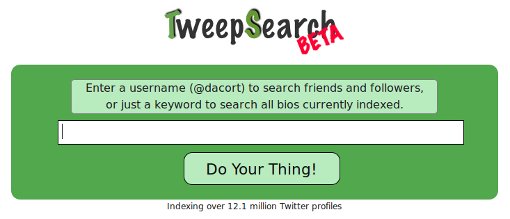
If you often search for people on Twitter, you should check TweepSearch out. It basically allows you to search for keywords inside the bio of other Twitter users. This is quite useful if you want to find Twitter users with a specific characteristic.

tweepsearch

For example, if you are looking to hire an SEO for your website you could search on TweepSearch for "seo expert," and the tool would output a list of all the (supposed) SEO experts on Twitter.

There is also a feature to narrow the results to Twitter users following or being followed by a specific profile. For example, you could search for all the "seo experts" following or being followed by Matt Cutts (if they are not, after all, they can't be real SEO experts…). To use this feature you just need to search for the profile first (e.g., @johndoe), and then search for the keyword.


Original Post: Search for People on Twitter with TweepSearch


Daniel Scocco Mon, 28 Dec 2009 11:46:53 +0000

To read the full article click here.

To unsubscribe from this feed, click here

To manage your other subscriptions, click here

Powered by RSS:Forward

Don’t Jump to Conclusions Based on Your Own Opinions and Preferences

Don't Jump to Conclusions Based on Your Own Opinions and Preferences

This tip looks like common sense, but most of us make the mistake of jumping to conclusions based on our own opinions and preferences (myself included) sooner or later.

For example, you might be designing your website, and you might need to figure out where to put the subscription box. Most people would think where they themselves usually look for subscription boxes, and then place it there.

The mistake here is the assumption that other people will have similar preferences and behaviors. This is obviously not always the case.

If you are not supposed to trust your own opinions and preferences, then, what should you do? In one word: test.

The only way to be sure about the preferences of your visitors is by testing. If you need to figure out the best placement for your subscription box, therefore, experiment with several spots and track the conversion rate on each of them. Then analyze the data and let the numbers tell you the best spot.

Summing up: just because you like something in some way it does not mean that other people will, too.


Original Post: Don't Jump to Conclusions Based on Your Own Opinions and Preferences


Daniel Scocco Tue, 29 Dec 2009 18:50:26 +0000

To read the full article click here.

To unsubscribe from this feed, click here

To manage your other subscriptions, click here

Powered by RSS:Forward

The Best of Copyblogger 2009

The Best of Copyblogger 2009

Best of Copyblogger 2009

You didn't think we'd close out the year without a "Best of 2009" post, did you? Well, you're not getting off that easy.

Here's the best Copyblogger content of the year, based on your enthusiasm via comments, links, retweets, and gratuitous offerings of produce-based holiday deserts. We thank you all for your continued support (even though we threw out the fruitcake, sorry).

Let's get started.

  • The First Rule of Copyblogger – It's a wonderful thing to wake up one morning, check the blog, and see that your Senior Editor has made a Fight Club reference that also establishes the underlying theme of the entire publication. Her name is Sonia Simone, her name is Sonia Simone . . . .
  • The Winnie the Pooh Guide to Blogging – Adding to a Copyblogger portfolio that includes drag queens, cross-dressing and what women really want, James Chartrand kicked off the year with blogging lessons from everyone's favorite Pooh bear. And you were shocked that he is really a she? Really?
  • 5 Steps to Going Viral on Twitter – Want traffic from Twitter? Read this post. Want the most possible traffic from Twitter? Post about Twitter.
  • How Twitter Makes You A Better Writer – In the most counterintuitive post of the year, Jennifer Blanchard makes the case that being confined to 140 characters improves your writing skills. Coming in 2010 – How Beer Makes You a Better Driver.
  • The Art of Writing Great Twitter Headlines – Twitter reinforces the single most important component to attracting online attention — the headline. Well, that and fake celebrity deaths. Better to stick with the headline skills.
  • 10 Secrets to More Magnetic Copy – First-time guest writer Jason Cohen knocks it out of the park with these quick and witty copy tips. He also forces us to retire magnetism metaphors indefinitely.
  • How to Turn Affiliate Marketing Disclosure Into a Selling Point – Everyone seemed surprised that the FTC said compensation disclosure laws apply to bloggers and social media just like other forms of media. I could say I told you so back in 2006, but I won't. Even though I did. Not that I'd mention that.
  • The Eminem Guide to Becoming a Writing and Marketing Machine – All you other Slim Shadys are just imitating, but you could do worse. Sean Platt lays down what Marshall Mathers III can teach you about taking your online game to the next level (without getting picketed).
  • The 7 Harsh Realities of Social Media Marketing – Did you notice all the "make money quick and easy with social media" hucksters that slithered out from under a rock (and then disappeared just as quickly) in 2009? This one's for those guys, and anyone who considered following their lame advice.
  • How to Write With a Knife – Check out this post if you want to improve one of the most important aspects of any type of writing — tight editing. Or if you want to see a cool picture of a blonde with a samurai sword. Whichever.
  • Since When Are Blogs Not Social Media? – Social networking went mainstream in 2009, prompting some who hopped on board in late 2008 to say they were giving up social media for blogging. What?
  • Blogging is Dead (Again) – The "blogging is dead" meme comes up at least once a year, but I only feel the need to respond every other year. I feel the same way about voice mail.
  • The 7 Deadly Sins of Blogging – Sonia reveals the seven sins that will cause you to fail online faster than hiring Robert Scoble.
  • Is Commenting on Blogs a Smart Traffic Strategy? – This was a rant in disguise after I'd had enough watching the less-than-smart strategies of some bloggers who left comments. Ironically, the post got 270 comments (and counting), but lame comments on Copyblogger subsequently decreased by 270% (or something).
  • Why You're Too Qualified and Respectful to Produce Great Content – This post is an absolute must read for everyone, unless of course you already know you should write assertively, or if you're busy doing something else, or just don't feel like it. Maybe later.
  • Seven Bad Writing Habits You Learned in School – Sonia and I would have liked to qualify this post a bit, but I'd like to see you try that with Jon Morrow when he's got a head of steam. So, a few English teachers got a bit upset, but we placated them with bouquets of gerunds.
  • Why Content is No Longer King (And Who's Taking His Place) – The content marketing revolution demonstrates that mere content is no longer king, and this post tells you who's taking over. No, it's not Elvis, nor is it a prime minister appointed by the Queen as Lord of Parliament and majority leader of the House of Commons.
  • The #1 Conversion Killer in Your Copy (And How to Beat It) – What do trolls, sea monkeys, shady carnival barkers and chronic halitosis have to do with online conversion? And what was Tiger Woods thinking? (Tiger's not in the post, I just really want to know).
  • 9 Proven Headline Formulas That Sell Like Crazy – Dean Rieck resurrects an old Copyblogger standard with these insanely effective headline templates. But please go sell crazy someplace else . . . we're all stocked up here.
  • Why You Can't Make Money Blogging – Poor Fake Steve Jobs discovers he's better suited for day jobs. Read this post to learn why "I want to make money on the Internet" is not a business model.
  • Is Your Tribe Holding You Down? – The post that defined the Third Tribe was inspired by a challenging email from Seth Godin and our refusal to switch to decaf. What does it all mean? You'll see in early 2010.
  • On Dying, Mothers, and Fighting for Your Ideas – No joke here, simply the post of the year. Thanks Jon, for sharing with and inspiring us all.

There you have it . . . the best of Copyblogger for 2009. Can we top it in 2010?

We'll try pretty hard. Hope you're along for the ride.

Happy New Year!

About the Author: Brian Clark is founder of Copyblogger and co-founder of DIY Themes, creator of the innovative Thesis Theme for WordPress. Get more from Brian on Twitter.


Thesis Theme for WordPress

Brian Clark Tue, 29 Dec 2009 15:46:52 +0000

To read the full article click here.

To unsubscribe from this feed, click here

To manage your other subscriptions, click here

Powered by RSS:Forward

Tuesday, December 29, 2009

Don’t Jump to Conclusions Based on Your Own Opinions and Preferences

Thank you for using rssforward.com! This service has been made possible by all our customers. In order to provide a sustainable, best of the breed RSS to Email experience, we've chosen to keep this as a paid subscription service. If you are satisfied with your free trial, please sign-up today. Subscriptions without a plan would soon be removed. Thank you!

This tip looks like common sense, but most of us make the mistake of jumping to conclusions based on our own opinions (myself included) sooner or later.

For example, you might be designing your website, and you might need to figure out where to put the subscription box. Most people would think where they themselves usually look for subscription boxes, and then place it there.

The mistake here is the assumption that other people will have similar preferences and behaviors. This is obviously not always the case.

If you are not supposed to trust your own opinions and preferences, then, what should you do? In one word: test.

The only way to be sure about the preferences of your visitors is by testing. If you need to figure out the best placement for your subscription box, therefore, experiment with several spots and track the conversion rate on each of them. Then analyze the data and let the numbers tell you the best spot.

Summing up: just because you like something in some way it does not mean that other people will, too.


Original Post: Don't Jump to Conclusions Based on Your Own Opinions and Preferences


Daniel Scocco 29 Dec, 2009


--
Source: http://www.dailyblogtips.com/dont-jump-to-conclusions-based-on-your-own-opinions-and-preferences/
~
Manage subscription | Powered by rssforward.com

Monday, December 28, 2009

Search for People on Twitter with TweepSearch

Thank you for using rssforward.com! This service has been made possible by all our customers. In order to provide a sustainable, best of the breed RSS to Email experience, we've chosen to keep this as a paid subscription service. If you are satisfied with your free trial, please sign-up today. Subscriptions without a plan would soon be removed. Thank you!

If you often search for people on Twitter, you should check TweepSearch out. It is basically allows you to search for keywords inside the bio of other Twitter users. This is quite useful if you want to find Twitter users with a specific characteristic.

tweepsearch

For example, if you are looking to hire an SEO for your website you could search on TweepSearch for "seo expert," and the tool would output a list of all the (supposed) SEO experts on Twitter.

There is also a feature to narrow the results to Twitter users following or being followed by a specific profile. For example, you could search for all the "seo experts" following or being followed by Matt Cutts (if they are not, after all, they can't be real SEO experts…). To use this feature you just need to search for the profile first (e.g., @johndoe), and then search for the keyword.


Original Post: Search for People on Twitter with TweepSearch


Daniel Scocco 28 Dec, 2009


--
Source: http://www.dailyblogtips.com/search-for-people-on-twitter-with-tweepsearch/
~
Manage subscription | Powered by rssforward.com

Saturday, December 26, 2009

The Long Tail: What It Means for Your Content

The Long Tail: What It Means for Your Content

This is a guest post by Mark Pack. If you want to guest post on this blog, check out the guidelines here.

The least popular posts on my blog are the most important.

Sounds like I've made a mistake in typing that sentence, doesn't it? But when it comes to reaching an audience, he top 10 posts in any month on my blog typically only account for between a quarter and third of the total traffic.

In other words, it's not the most popular posts that make or break reaching a good sized audience – it's the collective effort of the least popular. In my experience, many blogs have a similar pattern. It's an application of Chris Anderson's long tail idea. It also raises two questions. If this isn't the pattern on your blog, are you missing out on something? And if it is the pattern, how can you make the most of it?

If your pattern is different, it's worth asking yourself whether there is a good reason for that. A blog that regularly picks up large influxes of traffic from external sources, such as Digg, could expect the most popular posts to be a much higher proportion overall. But do think carefully about whether or not there really is a good reason for you not having a long tail effect. If you do, please do share your experience in the comments. If you don't, then there is an opportunity for you to grasp.

Whether it's creating your long tail, or improving on one that you already have, there are some similar steps to think through.

First, you need a steady supply of good content on your site. It's not just that search engines like sites with a solid record of quality content, it's also that your (potential) audience is not all made up of identikit people. More content does not just please search engines, it means you are more likely to have a post that suits what one of
your audience is looking for.

Moreover, it's quite common for people who are interested in the same information to be interested in it at different times. The bigger the archive of content you build up, the more likely it is that what interested you at some point in time is what someone in your audience is interested in right now.

Second, keep your old content updated. Many posts will happily stand the test of time, but where events or your knowledge have moved on, go back and update your posts.

Third, cross-link between posts. If people are still interested in your older content, it makes sense to make it easier for them to find it. Software solutions such as the "Yet Another Related Posts" plugin for WordPress are a handy way of generating automated links to similar content at the bottom of your posts. Tags and categories are another way of getting links through to other posts.

However, you usually get much better click-through rates from links in the body of the post than you get from a list of other content below or to the side of the post. So work in references and links to your older posts as you write new ones.

Fourth, keep an eye on your blog statistics. Amongst the long tail there may be some surprisingly popular posts. That gives you a clue as to what topics may be good to return to or write about more often than you were planning to.

In my own case, for example, I have found that my occasional historical posts often pick up a low but steady trickle of traffic. When I look back over a period of several months, posts that seemed to get very little traffic at the time of publishing suddenly look much more successful. In my case, this traffic does not appear to be from
the core audiences I would like my blog to reach, so it has not resulted in me significantly upping the historical content. However, your experience may well be different.

Got any other suggestions? Do share them in the comments below.

Mark Pack is Associate Director, Digital at Mandate Communications, a London-based integrated communications specialist firm. He's on Twitter as @markpack


Original Post: The Long Tail: What It Means for Your Content


Daniel Scocco Fri, 25 Dec 2009 12:05:04 +0000

To read the full article click here.

To unsubscribe from this feed, click here

To manage your other subscriptions, click here

Powered by RSS:Forward

Social Media Trends to Watch in 2010

Social Media Trends to Watch in 2010

Merry Christmas for those of you who commemorate it. I believe you guys won't have much time (let alone patience…) to read blogging tips today, so I'll just leave you with a cool link that I came across last week. It is titled 10 News Media Content Trends to Watch in 2010, and it was published at Mashable.

Here is the first trend:

1. Living Stories

One of the difficulties of the web is being able to really track a story as it develops and creating engaging formats for long-form articles. The article page is often the only thing that a reader sees and not the story in its full context. In 2010, news organizations will design stories that are more suited to the way readers consume online content.

One early sign of this is the recent collaboration between Google, The New York Times, and The Washington Post on the Living Stories project, an experiment that presents coverage of a specific story or topic in one place, making it easy to navigate the topic and see the timeline of coverage on the story. It also allows you to get a summary of the story and track the conversations taking place. This format contextualizes and personalizes the news.

Check out the full article to read the other nine.


Original Post: Social Media Trends to Watch in 2010


Daniel Scocco Thu, 24 Dec 2009 16:58:02 +0000

To read the full article click here.

To unsubscribe from this feed, click here

To manage your other subscriptions, click here

Powered by RSS:Forward

ViaNett SMS - test account

Dear kokode,

Here is your account information. Please contact us if you want any further information about our products.

You can send until 10 SMS messages in the test period, pricegroup and sender address will not be available in this period.

Customer pagehttp://sms.vianett.com
Usernamesetyawanbayupamungkas@gmail.com
Passwordmyfi
Prefix (SMS client)send DEMO116744 to +4560991000


You may purchase SMS credits with your credit card by visiting this page

ViaNett's SMS services are intended for business use. An SMS account for consumers can be created at http://www.talksms.com/


Best Regards
ViaNett AS

Happy Holidays from Copyblogger!

Happy Holidays from Copyblogger!

Happy Holidays

Here's to a safe and joyous holiday season for you and yours. In case you're actually looking for something to read, here are some Copyblogger gems for your solstice surfing pleasure.

See you next year!


Thesis Theme for WordPress

Brian Clark Thu, 24 Dec 2009 20:25:32 +0000

To read the full article click here.

To unsubscribe from this feed, click here

To manage your other subscriptions, click here

Powered by RSS:Forward

Five Smart Things You Can Still Do in 2009

Five Smart Things You Can Still Do in 2009

image of highway sign

Copyblogger is about to go on our annual holiday hiatus. We'll be taking a break from posting while we catch up, get rested, and get excited about what we've got in store for you in 2010.

You may be taking a little time off yourself. Or you may still be going into the office, but the last week of the year is often a time when routine tasks slow down or stop altogether.

So what's the smartest, most productive use you could make of the next seven days?

Here are five ideas that will let you take what some people think of as "dead time" and use it to jump start your year in 2010. Doing any or all of these will get you energized and excited for the year to come.

1. Create a quick product

The biggest obstacle most bloggers face when they want to make money is they don't have anything to sell.

And the biggest obstacle to creating something to sell is that it seems overwhelming. We feel like we've got to distill everything we know into a 400-page ebook or 30-hour marathon audio course.

That's why I was so impressed by a recent post from Dave Navarro about creating a product over a weekend, and his follow up post on
how to know if it's the right time to create a product.

If you've got even one or two slow days coming over the next week, take Dave's advice and create a small, low-cost product. It doesn't matter if you have four blog subscribers, three of whom are related to you.

A few people may buy it, and that's great. They'll tell others about it, and that will start attracting the targeted audience you need in the future (generating more sales).

More importantly, it will elevate you in people's eyes as a solution producer and not just a blogger. Big difference.

2. Write a series

If the idea of creating a product is still too scary, put it on your calendar for January. And instead, every day for the next seven days, write a post for a series for your blog or email newsletter.

What should your series be about? It should be about the most compelling, thorny problem your audience regularly faces that you're passionate about fixing.

Solve some problems worth solving. Don't wimp or waffle around, and don't sell yourself short. Give your audience real answers they can start using right away.

3. Reconnect with your favorite bloggers

Sometimes the "social" in social media threatens to eat every minute we've got to give.

If you find yourself with a little down time next week, spend a few minutes and reach out to some of your favorite bloggers in your topic. You know, the ones you haven't had any time to read in the last six months.

Read through their last 4 or 5 posts. Look through their archives or popular posts. Make some intelligent comments. If something useful presents itself, link to them in your series.

4. Create some audacious goals

I know, I know, nothing is more boring than telling you to set goals around this time of year.

But here's the thing. Wildly exciting goals lead to wildly exciting results. (Not always, or even often, the precise results you visualized. Don't let that worry you.)

Some time before December 31st, take an hour and write down the most perfect imaginable day for yourself. Where you wake up (and with whom), what you see, what you have for breakfast, what you do and where you go and how you do it. How you feel about everything you're doing and seeing. How you look. What you smell and hear.

Use every ounce of writing skill you've got to make this description vivid. Sell yourself on it.

And try not to be too "realistic." Let your dreams soar a little.

Then set a reminder in your calendar to take a look at this "perfect day" once every three months in 2010. Each time you revisit it, re-copy what you've written, making any tweaks you want to.

I promise you, in December next year, you'll be a little spooked by some of the "unrealistic" things you wrote down this year, and how much more realistic they've become.

5. Sign up for some high-quality (free) education

If you haven't joined us yet for Copyblogger's free Internet Marketing for Smart People e-newsletter, you should sign up for it now. It starts with a 20-part course on some of the most important building blocks to marketing your product or service online.

The newsletter will give you the marketing tips and techniques that work in the real world, including the smartest strategies for marketing with social media. And we do it without the annoying sleaze and hype you see from too many other "gurus."

If you're planning on putting one (or all) of these into action by December 31, let us know in the comments! (And then come back on January 1 and let us know how you did.)

About the Author: Sonia Simone is Senior Editor of Copyblogger and the founder of Remarkable Communication.


Thesis Theme for WordPress

Sonia Simone Thu, 24 Dec 2009 16:10:13 +0000

To read the full article click here.

To unsubscribe from this feed, click here

To manage your other subscriptions, click here

Powered by RSS:Forward